
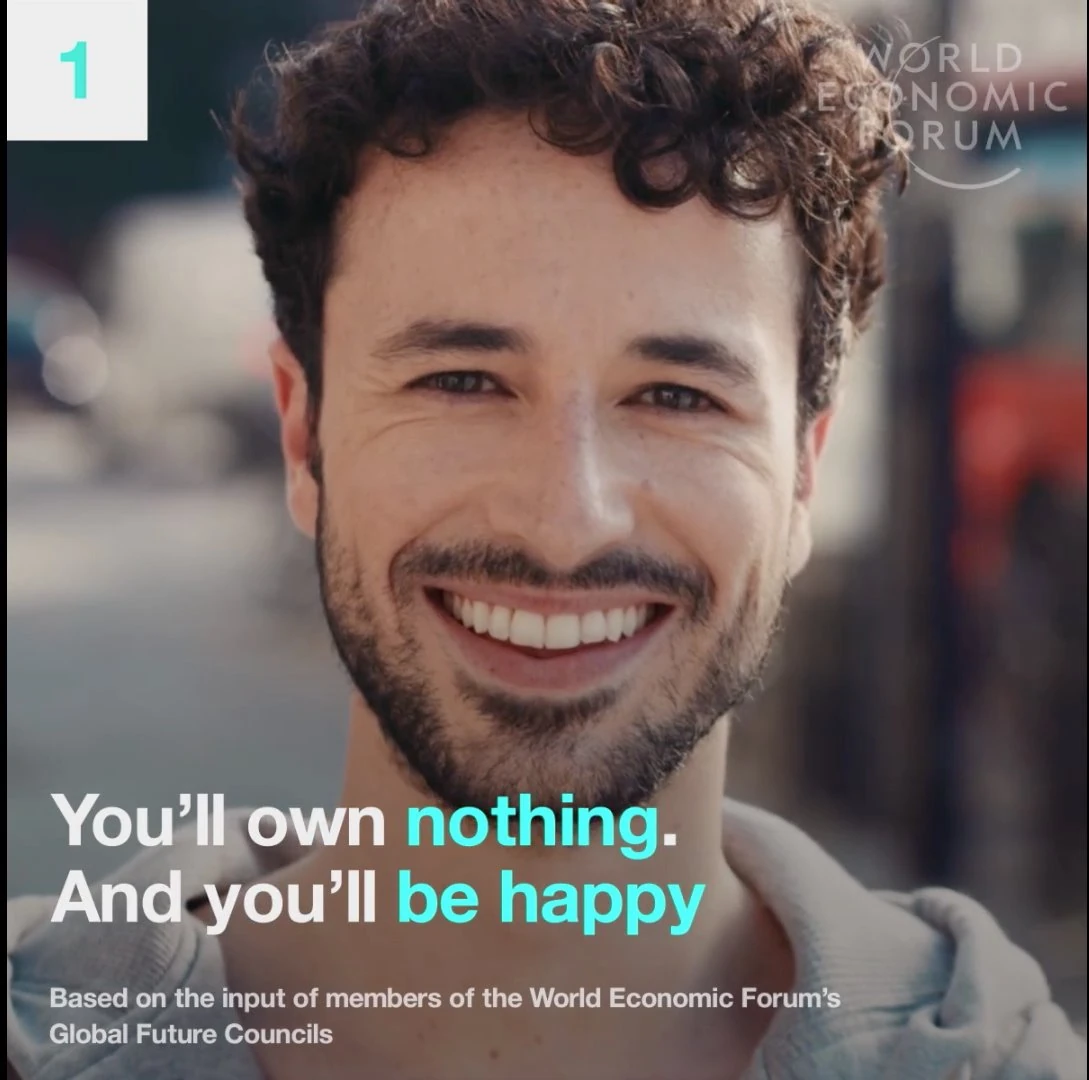
“You will eat ze bugs!”, “You will own nothing and you will be happy!”, phrases many of us have heard time and time again but did the WEF actually say these things and endorse them?
This thread is designed for you to bookmark, retweet, like and save so that you and others can easily access the proof to these common talking points at the click of a button.
“You’ll own nothing. And you’ll be happy”
This comes directly from the WEF’s “8 Predictions for the World in 2030” video. There are various claims as to where this video was published, one says it was in an article on their website called “8 predictions for the world in 2030”, now deleted, another says it was from “the future of jobs report 2017” which either didn’t exist or has also been deleted from the WEF website, and even more say it was on YouTube but was deleted.
The video, however, is still in circulation, which I’ll post in the thread. Using the way-back-machine, an internet archive, I was able to access “8 predictions for the world in 2030” on the WEF website, written by Ceri Parker, Commissioning Editor, Agenda, World Economic Forum.
This is the first prediction, which lines up with the video’s “You will own nothing, and you will be happy” except in this version… it’s a little less happy:
“1. All products will have become services. “I don’t own anything. I don’t own a car. I don’t own a house. I don’t own any appliances or any clothes,” writes Danish MP Ida Auken. Shopping is a distant memory in the city of 2030, whose inhabitants have cracked clean energy and borrow what they need on demand. It sounds utopian, until she mentions that her every move is tracked and outside the city live swathes of discontents, the ultimate depiction of a society split in two.”
All predictions in the article:
1. All products will have become services.
2. There is a global price on carbon.
3. US dominance is over. We have a handful of global powers.
4. Farewell hospital, hello home-spital.
5. We are eating much less meat.
6. Today’s Syrian refugees, 2030’s CEOs.
7. The values that built the West will have been tested to breaking point.
8. “By the 2030s, we’ll be ready to move humans toward the Red Planet.”
All of these line up with the video, but written in different ways, and ordered differently. So it is safe to say the video was produced by the WEF and the phrase is true.
According to “the Sociable”, WEF Managing Director Adrian Monck denies that they ever supported the phrase “own nothing, be happy”. He claims it was an anti-Semitic slur originating on an online forum. This seems to be a misdirection and a play on words however, as that phrase is different from the phrase in the video.
“Penetrate the cabinets”
This is an actual quote and is not taken out of context, video below. Klaus Schwab, the leader of the World Economic forum said this in front of a large audience whilst he was explaining that many “young global leaders” are apart of the World Economic Forum and are working towards the goals of the WEF. It essentially means that he and the WEF aim to install leaders who are sympathetic and/or actively working towards the goals of the WEF in all major governmental leadership positions around the world, thus his aim is undeniably to penetrate the cabinets in the typical context that it is used.
“What we are very proud of now […] is that we penetrate the cabinets. Prime Minister Trudeau […] Half of his cabinet are actually “Young Global Leaders” of the World Economic Forum…” – Klaus Schwab
“You will eat the bugs!”
I can’t find anything of Klaus Schwab ever saying this. However, the WEF have supported the underlying concept behind that phrase. Here are some articles I pulled directly from the WEF website:
5 reasons why eating insects can reduce climate change. – Amrou Awaysheh (This is the only one that is titled as an “opinion” piece).
Why we need to give insects the role they deserve in our food. – President and Chief Executive Officer, Ÿnsect.
Good grub: why we might be eating insects soon. – Sean Fleming, Senior Writer, Formative Content.
Could insect farms meet our food demands of the future? – Karl Plume Reporter, Reuters. “This article is published in collaboration with Thomson Reuters Foundation trust. org”.
And from this last article I named, I pulled this:
“Nutritionists and scientists have long touted insect consumption for humans as a sustainable and cheap source of protein, but snacking on bugs is a stomach-churning prospect […] Introducing insect protein further down the food chain may be more palatable.”
From what I’ve seen, the main way to get people to “eat ze bugs” is through a protein powder/paste made from crickets and mealworm. Most likely in the form of burger patties and similar meat product imitations.
There are multiple companies that have already begun mass production of insects to be used in food products, one notable company is called Ynsect, who’s president has written articles for the World Economic Forum.
Eating insects, according to the WEF and contained in the articles I named, is a cheaper and more efficient option than both animal farming and soybean farming.
Whilst doing research for this I also found a lot of videos of what seemed to be Klaus Schwab saying, “You vill eat ze bugs!” but they were made with AI and weren’t actually real.
Many celebrities have endorsed eating bugs including Nicole Kidman and Robert Downy Jr. (videos in thread) and there is a clear trend in mainstream media and Hollywood to support eating vegan products and/or insects. Contradictory by ideological standpoints yet makes sense when considering the WEF’s view on what types of farming are more viable economically, and their enthusiasm to sway high profile people to support their program.
Is Argentinian President Javier Milei working with the WEF?
As far as I can tell, he isn’t very supportive of the WEF, he may at some point have wished to work with them and he does appear on their website, but the video of him in a WEF panel, which I’ll post below with an English voiceover, shows that he is against the typical Keynesian-Fabian socialistic theme of the World Economic Forum. In the video he is actually arguing the point to the panel that libertarian free market economics is superior, something which would clash with the WEF’s direction.
Javier was the senior economist at HSBC bank, it is no stretch of the imagination to think that it would be enticing for a senior economist to be recognized as apart of something called the World Economic Forum for status reasons, rather than ideological ones. However, I can’t rule that out.
From the above you can see clear cut explanations of common accusations in as unbiased of a manner as I could make it in regards to some of the major online talking points for why the WEF is a danger to society.
Alex James.